
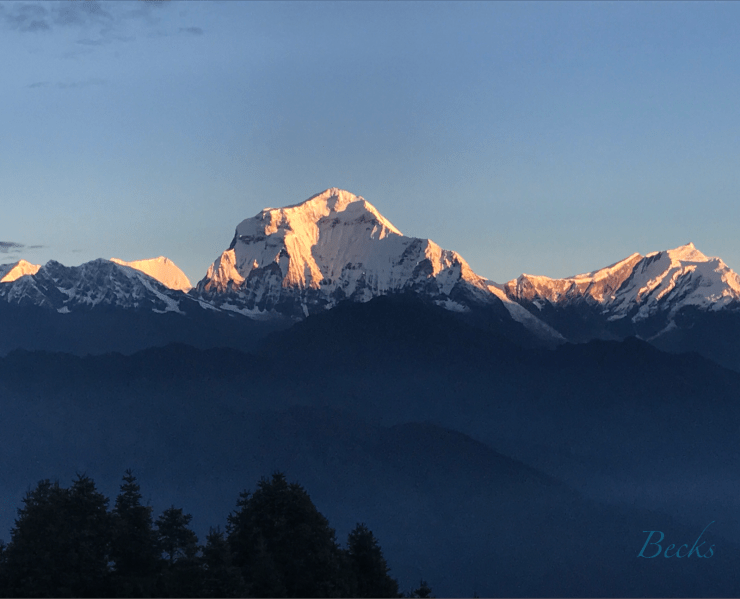
Mooting the idea…
Doing a trek in Nepal has always been on my bucket list, but I have never thought that I could actually fulfill my dream so quickly. Nepal is an unfamiliar country to most of my friends; a rugged country that is shrouded in mystery and unknown. Visiting the country is already pretty exotic in itself, let alone trekking or mountain climbing. It is home to the famous Himalayan and the world’s highest mountain, Mount Everest, the mountain that inspires greatness and yet strikes fear in the hearts of those bold enough to even hazard the thought of climbing it.
In recent years, and especially following the 2014 earthquake, much publicity and awareness has been created on this country, and we see many travel groups starting to organize Nepal treks; promoting tourism so as to help with the on-going rebuilding efforts. Getting into the country and talking to the locals, you will realize that tourism is truly the most important revenue generating industry for the country. Tourism pushes the country towards modernization; young people have to pick up English to be able to work in this industry, and other related industries such as hospitality and retail followed suit to take a piece of the pie. To help the country is to visit and it is certainly a country well worth many trips to come.
Things moved quickly, a couple of Whatsapp messages, checking of flights and accommodation, and getting the contact for a reliable tour agency, my friend and I confirmed our trip in April. Experienced planners as we are, choosing the period to trek in Nepal turned out to be the most careless mistake that we’ve made. We chose first week of September more out of convenience, neglecting to check the weather condition. According to most websites, this is at the tail-end of monsoon with rain still being anticipated. 3 weeks before our date of departure we started checking out weather forecasts and all days of that week indicated rain and storm! We even tried to change our flights to other dates, but at such short notice, this has been proven impossible. When it comes to the weather, there is only one thing left to do – pray, and mentally geared up for a wet and difficult trek. Nonetheless, the hope that perhaps it will all turn out well is still high. After all, we will be fulfilling our dream of trekking in Nepal. Surely it cannot get any better than this. The mistake we thought we made turned out to be the most memorable experience we have ever had.
Getting Prepared…
I can’t say I am always in tip top physical condition, as such it was indeed a very impulsive decision to book a trek to Nepal without any plans to train up. Poon Hill Trek is but only a 5 days trek, as compared to the more popular treks such as Annapurna Base Camp that will need at least 8-9 days. With 6 months advance booking, I told myself surely I will have enough time to whip myself into shape to survive the trek. In reality, with the most busy work schedule and frequent travels, time flew by so fast before I could get my act together to build up any physical strength. About the only achievement I have made during these 6 months was to cut my weight down by 3 kg. At the very least it will be a lighter me going to Nepal.
Preparation for Nepal meant tons of internet research on the terrain for this trek, the details of the trek by the day and what to pack. I have read blogs after blogs on trekking in Nepal, scrutinized the program itinerary and figured out on the map our trekking route. I also carefully recorded the distance between each location, how long I need to walk everyday and the temperature at these places I will be visiting. I was as familiar as I could be to prevent any unwanted surprises along the way.
My Packing List…
Next came the packing list. After much research on blogs of those who have done the trek, I realized I can’t bring myself to follow some of the good advice, much as I wanted to. Besides the essentials for the trek, most blogs focused on traveling light. My packing practically fly against this objective of traveling light, but I have good reasons…
- 5 different sets of clothes, one for each day of trek. One of the things I absolutely needed to have was fresh set of clothes everyday. Regardless of the weather it got to be long trekking pants to prevent my skin from being exposed to the elements of the surroundings. So 5 sets of trekking clothes into 5 different vacuum bags, squeezed to the max for space saving. I was absolutely happy to get into clean dry clothes every morning. Yes it is a luxury, but it helped with the framing of mind to get mentally prepared for the day’s trek.
- 3 pairs of stockings. According to some obscure website, wearing stockings will prevent leeches from getting on to the skin. I am happy to report that there were certainly no leeches caught on my legs. There were a couple of close calls, 3 leeches were found on my shoe and at the end of my pants, but none touched my skin. I can’t say for sure if stockings worked, however it does not take up space and it requires no effort except to put them on, so it is still a worthwhile item to bring along.
- 4 energy bars, 4 blocks of energy gel, 2 tubes of hydration tablets to make energy drinks. Among all these energy enhancers, only the tablets proved most useful and palatable. They made the water much more refreshing to drink and it did provide the booster when fatigue set in. The energy gel worked too and certainly tasted much better than the energy bars as they were less sweet. However, I only ended up consuming 2 blocks: since it is just not so appealing to chew on something while trekking. The energy bar was such a disappointment, it was way too sweet even when the packaging stated less sugar. I had to share out 2/3 of the bar in order to get rid of it. I ended up having to bring back 3 of the left overs.
- Branded hiking shoe vs Kampung Adidas. I brought along my newly bought (but thoroughly broken-in) hiking shoe, however it still could not provide the grip for slippery stone steps. My friend swore by Kampung Adidas, a rubber made local unbranded shoe that is popular with hikers in Malaysia and Singapore, and claimed that it really provided the grip. It is also lighter and less bulky that my hiking shoe, but it is low cut which does not provide the ankle protection as my high cut hiking shoe. In addition, it leaves a lot to be desired in terms of style and it went pear-shaped after 3 days of wearing. However, all these would not have mattered if you are slipping off wet stones, which I did with my fabulous hiking shoe and ended up falling twice. Besides, Kampung Adidas won hands down on price. It is barely RM 8.90 in Malaysia!
Other items which I find extremely useful and was very grateful for:
- Sunblock, even though with it, I was still burnt at the neck and face.
- Socks, not only fresh ones for each day but one pair to sleep in. It kept me warm at night.
- Slippers, for the tea houses and even hotels as some do not provide slippers
- Wet wipes, those heavy duty ones that hospitals would use, they provide a good rub down when we break for lunch.
- Tissues, they can never be found in any tea house washrooms.
- Sleeping bag liner, this came in handy every night at the tea houses. The beds were clean, but there is no harm putting a sheet between you and the mattress, and it added warmth during those nights higher up the mountains.
- Trekking pole, this borders between being very useful going down steps and hills, and being such a chore to carry while climbing up.
- Sweatbands for wrist, they were a great substitute for tedious towels to wipe down your sweat while trekking
- Bubi bottles, they take in hot or cold, hangs on bags easily and can be folded away when not used. 2 Bubis saw me through the 5 days, day and night.
- Vacuum bags, to compress everything into your luggage. You will be amazed by how many things you can squeeze into them.
- Backpack on wheels, why tire yourself carrying your backpack when it can just roll along behind you so long as the terrain permits?
All in all, with everything packed in, my luggage came up to be around 12.5 kg, just barely 3kg more than my friend’s, not bad for an amateur trekker at all!
Day 0 – A Tale of Two Cities. First Impressions.
This is the day before the trekking start. There was nothing on the itinerary besides meeting the guide, hop on to the tourist bus along a busy street in Kathmandu and set off to Pokhara. Arriving late in Kathmandu meant that we did not see much of the county the night before, and so the 6 hours ride to Pokhara presented a great opportunity to see the city and its countryside.
Kathmandu
Our guide is a lean young man who speaks fluent English. He was kind enough to carry my bag while we walked to the bus. As it was still low tourist season, our bus was practically empty with less than 10 passengers including us. We were happy to park ourselves besides the window to catch some great views along the way. Since it was still a little early and we all did not have any breakfast, our guide took us to a roadside stall selling pots of hot tea with milk boiling over the stove. I wasn’t sure what to make out of my cup of hot milk tea, but tasting everything local was certainly in the plan, part of the cultural immersion experience of this trip. This roadside brewed milk tea over charcoal on a cart became our first taste of something local.
First impression of Kathmandu in the early morning was not really much of an impression. This is a much neglected town, even though it is the capital of the country, the largest metropolis in Nepal. This is the city where the olden palace and government bodies reside, but it looked like a city of no importance. Everywhere, roads are in disrepair with large potholes being a common fixture. Streets are full of rubbish; dust flew everywhere and made everything displayed outside the shop looked unappealing. Vehicles that looked like 20 years old jammed up the road, looking as though they can break down anytime. Rows of run-down buildings are built very near the side of the road, which makes it very difficult for pedestrian walking. They are not more than 5-6 stores high, as though the capability of buildings higher has not reach this city, or it could just be due to the earthquake. Lower buildings provided easier escape, surely. Our guide explained, since an earthquake, or landslide will turn everything into rumbles, the government could have decided that any rebuilding efforts in the city is futile.
The city certainly has the 50s feel to it. Its skyline are laced with thick cables, connected to gigantic poles of wire, going out to buildings around it. The humongous connections of wire at the electric poles made you wonder what would happen if just one connection sparks and catches fire? Yet, the city definitely has signs of modernization and globalization with English signboards punctuating the Nepali ones up on the buildings. Inside the comfort of the spacious tourist bus I saw the drivers on the road braved the big trucks, traffic jams and loud horns. Just another day in Kathmandu.


When we finally got over the jam and started climbing up the hills outside of the city, we welcomed the change of scenery from densely populated housing to lush green mountains, with the well terraced slopes, here and there dotted with farmsteads. Narrow winding roads weaved through the mountains. Even outside of the city, the traffic continued along these narrow single lane roads. A slight left would mean certain death. Another attraction of Nepal is the many rivers that flowed through the forests, formed by the waters from the waterfalls high in the mountains. The banks of the river are connected by long, but sturdy suspension bridges. The 6 hour ride guaranteed scenes after scenes of greenery, and gradually lulled us to sleep as the bus pushed towards the city of Pokhara.


Pokhara
You would think Pokhara is going to be just as antique as Kathmandu, and you would be surprised. Situated 200km away from Kathmandu, it is actually 9 times larger than Kathmandu. Walking along the streets of Pokhara, you see wider streets filled with tourist shops selling colourful wares and surprisingly a lot of foreign restaurants serving mostly Chinese, some Korean and Japanese cuisine. Due to its proximity to the China border, we were told that foreign Chinese investment is aplenty in this town. Travelers via land going into China would also inevitably pass by this town. With the influx of foreign investment came city development. Roads are wider and better maintained, roadside cafes littered along the streets and fancy, hip hotels can be found everywhere, even in the back lanes.
One of the key attraction of Pokhara is the beautiful Fewa Lake, the most visited tourist site in the city. It is just a stone throw away from Lakeside Road, the main tourist belt. Over the waters dotted colorful boats, waiting to be rented for those who wished to get across the lake, or just to row for fun. Some boats are larger, with shelters, other are paddle boats that seemed to require a lot of effort to make them move, but the rest are mostly small row boats that barely sit two. The path along the lake was well landscaped with shelters you can stop to admire the view. On other side of the path, there were a few paddlers selling their wares. The sight not to be missed are the cows. It is after all a Hindu country, and cows are allowed to roam freely. They formed part of the residents just like the locals.


It is late monsoon season, the clouds were still thick, and very soon, it started to drizzle. We duck into one of the many al fresco style cafes along the lake, and decide to order a drink while waiting for the rain to pass. Our guide decided to also take the opportunity to briefed us about the trek starting early the next day. The topics were wide, from the terrain to the tea houses and the price of food and water. He covered the weather and what to expect during each day of the trek, including the chances of getting some leeches. We took in all these for our mental preparation of what is to come. We were as prepared as we can be for our Poon Hill Trek.
Day 1 – Putting Our Best Foot Forward.
Rising early, bags packed and with a standard breakfast, we passed our bags to our porter, who joined us this morning. Our porter is quite a few years younger than our guide, a tall, scrawny fellow. I was a little worried if he can indeed carry our bags, with a total load of around 25 kg. To add to this unpleasant task, the travel agency gave us 2 large sleeping bags, which we anticipated will not be used. However, the guide being the dutiful employee of the agency decided to follow instructions to carry these large sleeping bags along, and the unnecessary task fell onto our scrawny porter. I personally felt bad, my luggage is an old backpack on wheels that came with no padding for comfort, and it was the heavier of the 2 luggage. I comfort myself by thinking that I would be most willing to compensate more for his discomfort at the end of the trek.
Subsequently I realized that my concern was ill founded. Our porter was fit as a bull! He skillfully tied up 2 backpacks, 2 sleeping bags, plus a carry on for his own using a strong rope, and carried these effortlessly on his back. With swift and steady steps he led the group on the treks everyday together with my friend, who matched his steps throughout the trek, leaving me and our guide to plod along far behind. Days later, as we got friendlier with our porter, he showed us his most defined biceps which was most impressive! I really didn’t need to worry about him at all!
Nayapul
A short but extremely bumpy ride to the town of Nayapul brought us to the start of the trek for the day. It was still early so the town seemed deserted, not a lot of shops were opened yet. It is a functional town, with buildings made of stone walls and steel roof. There were eating places and big beer sign boards, catering to the trekkers who must start here for their treks to all Annapurna routes. Tradition still prevailed nonetheless where around corners of the town, you can still see the colourful banners hanging high on the poles, the sight that most people come to associate Nepal with.


The view of the mountains behind this town is a panorama of green forests, punctuated by blue roofed houses. Beneath, the waters from the mountains gushed through broad rivers and big boulders, creating sounds of rushing waves. The sound of flowing river, at times louder, at times softer, will be our constant companion for the next 5 days even at night when we sleep. This is the sound of nature, not the sound of traffic and chatters as you would hear living in a city. Many times at night when I sat listening to just this sound of waters and possibly the sound of insects, I can imagine another life beyond my work and worldly cares, and wished that time would just stop so that I can remain in that moment and never return to real world.


Crossing the river on a suspended bridge, we stopped at the checkpost where our guide checked us into the Annapurna Conservation Area. I wasn’t paying attention at that time, but our guide did mention, 5 days later, we will be back to this same checkpost to check out of the park. I didn’t take this to heart, but little did I know, I would go into the mountains the old me, and emerged a changed me, right back at this very same checkpost.


The entire trek for this day was divided into 2 distinct parts – the road and the path. The road trek was the prelude to the forested paths we will be trekking for most of the days. I forgot how long I walked for this part of the trek, all I knew was to plod along until my guide told me at some point that the road had ended and the path into the forests began. The path wasn’t just slopes, but also steps, and I came to realize very soon that steps will become the feature of our trek. The steps were mostly made of stones, laid down to define the way into the forests or wooden slabs put in place to create a step. The steps were gentle for which I was most grateful, not big high steps that will guarantee muscle aches in no time. It was mostly these gentle steps and forest paths that led us gradually up to one blue roofed cluster of tea houses after another, and finally to the one that we will stay for the night at the town of Tikhedhunga.
About the only significant memory from this day was how uncomfortable I was during the trek. At the onset, it was already very obvious that my stamina was just not cutting it. My pace was erratic; I tire easily and I was panting away almost all the time. No, the path wasn’t tough, just long; the weather wasn’t too hot as we headed towards higher altitude, but i was just so exhausted all the way. Trekking, to me, is mind over matter, and it is just how you motivate yourself forward. However it doesn’t always work this way, so I found myself sometimes faster and at times just don’t feel like taking another step at all. What a rough start for me, and I was honestly quite worried how I could survive the rest of the trek. My guide was too kind, he said that this is normal for everyone starting on the trek, it will only get better when I get used to it. I appreciated the kindness, but I seriously doubted his words.
Tikhedhunga
The experience of staying in the mountain tea houses of Nepal were in my opinion, underrated. There were many pleasant surprises on my first night at the tea house in Tikhedhunga. The room was basic, sparsely furnished with only a small tabletop for you to put your stuff. The mattress was clean and good enough for a night’s stay. There was also a small window which you can open a little for ventilation, Subsequently in the other tea houses, the weather dropped at night and it would be too cold to open the windows. Initially I was worried that there wasn’t any blanket provided and I had to use the sleeping bag, which didn’t look all that clean. I was overjoyed when thick warm blankets arrived, and with my brand new sleeping bag liner over the mattress, I was set for a very good night sleep.
Tea house structures tend to be very standard. There will be a block for rooms, and rooms tend to be in a row, dormitory style, with a common corridor and chairs outside your room to sit. As the rooms were tiny and stuffy, we spent most evening sitting outside our rooms enjoying the cooling breeze of the mountains. At the center of all tea houses will be a restaurant or a hall where people gather in the evening, for food, for chats or just to read. For those tea houses higher up the mountains where the temperature is lower, there is a central heating area in the hall where wood is burnt in a stove. The heat surrounding the stove is used to heat up the hall and dry the clothes that hanged over the stove on ropes. We took advantage of that each night to dry our clothes, else clothes left out in the cool air remained damp with the morning dew.

Electric sockets are not always provided in the rooms, but certainly will be found in the hall. Internet is always available, at least on menu, but not all are strong enough, and some only restricted to the hall area. For people whose worlds exist via a small screen on the mobile, it would be most frustrating to try gaining access to data over very slow or even non existent internet speed. Unlike my friend who had better foresight, I actually did packed in a book in my luggage, the smallest one I could find in my house. Turned out I’ve never gone pass the cover. Besides spending my time battling the internet, I was busy editing the photos I took during the day. This is a massive task with an estimated 300 or so photos taken throughout the trip.
The next hurdle to cross is to shower. Hot waters are piped into the washroom, and almost all tea houses provide them at a cost, some even have instant heaters. However, the facilities of the bath are basic, with hardly anything to hang your toiletries and clothes from. I was already thankful for hot water, so I made do with whatever there is. I tried not to look too hard at my surroundings. The wash area was clean enough for a shower, and that’s about all that mattered. Western toilet, as they called it, is also available in all the tea houses we stayed during the trek, usually found at the end of the long corridor of dorms. I could not have asked for more. Just remember to bring along a pack of tissue whenever you need to go.
An Interesting Night…
The first night at Tikhenhunga was an interesting one. The tea house compound is a U shaped structure of buildings consisting of the row of rooms, separated from the restaurant area and the kitchen. The one and only source of running water from a tap was a wash basin built in the middle of the square-ish courtyard as a standalone structure. The restaurant was not connected to the building where the rooms were, and when we were done with dinner, it poured. Our guide was saying that it is better to pour at night so that the day is cleared of bad weather, and we will have good weather for our trek in the day. Therefore, rain was indeed welcomed at night, except that I had to brave the rain to get to the staircase to go up to my room. The staircase wasn’t sheltered either. We waited for the rain to get lighter before we braved it. At some point during the heavy rain there was a commotion, the water supply was cut, somehow, due to the rain. Now that caused a few problems, I still have to use the toilet and we still need water to brush our teeth. We were told that they were fixing the problem and the water supply will resume after 30 mins or an hour. That didn’t affect my friend one bit and he promptly completed the task of brushing teeth with a jug of water from the kitchen. I waited as long as I could but gave up in the end. Feeling so self-conscious brushing my teeth with someone waiting besides me with half a jug of water just wasn’t an experience I’d care to repeat, under any circumstances.
Day 2 – Stairways to Heaven
The moral issue with the leeches…
The night before over dinner, we had an in-depth discussion with our guide on the issue of leeches, something that he was very certain we will encounter on Day 2 of our trek. He cautioned us to alert him if we felt the slightest itch anywhere along our legs, feet or toes, which might indicate that a leech has gotten to us. We discussed ways of killing leeches, by fire, by salt; and ways of preventing leeches, using strong insect repellent or rubbing local peppers on your shoe, as recommended by some websites. At the end of the conversation, he appealed to us not to use strong insect repellent as it will certainly kill the leech and other insects might also ingest the insecticide and be killed. That would upset the ecosystem in the forest. I totally support this thinking, but I needed to survive on my own first. Next morning, selfish as I was, with the most scary images in my head on these blood suckers, I still picked up the bottle of most expensive DDT insect repellent that I bought at a trekking specialist shop, and strayed generously over my boots. Our guide watched at the side while we diligently “protected” ourselves with the repellent before we set off for the day, but I could almost feel the look of disapprove from his silent demeanor.
All my research on this trek tells me that Day 2 going from Tikhendunga to Ghorepani is the hardest. This is the dreaded day of having to climb 3,500 steps up the hill to Ulleri, followed by another couple of hours of trek before we can reach the town of Ghorepani. I survived the first day’s trek with a below average result, so I mentally braced myself for a very tough day ahead. The very good night sleep helped a lot, at least on optimism, but I wasn’t sure if physically I could actually pull through.
After crossing a suspension bridge over a river stream with the iconic blue thatched tea houses at the side, the steps began. I decided to change strategy this time. Taking things really slowly, I climbed the steps at just enough pace to move at a steady constant speed faster that normal walking pace, yet, not fast enough to make me go out of breath. In this manner, I noticed from my Fitbit watch that my heart rate did not go beyond 110-120 bpm throughout the climb. I did not feel tired, and found that I could go on at this speed for a very long time. This turned out very well for me, except that my speed was then really slow compared to the rest. Our porter probably could not take my snail pace and sped way ahead with the load on his back. My friend followed suit since the porter’s pace seemed to suit him better. Our guide had no choice but to accompany me and take baby steps. Many a times he would stop quite a few steps up ahead of me and turned silently, looking at me plodding up the stairs with an expressionless face. He was never upset, always patient, but I often can’t help wonder if he would have wished he could switch places with the porter on this trip. He would still point out interesting sights to me along the way, or pretty flowers growing by the side of the path. Sometimes when my pace permitted me to hold a conversation without panting, we even ended up chatting along the way. I got to know a little more about him, and from him a life of a guide, who worked hard from a porter to a porter guide and then to a full-fledged guide as he is now, so that he can provide a better life for his wife and baby. He can be quite humorous and chatty at times, and at other times, he feel silent as the topics ran out, and we both ended up lost in our own thoughts as we edged ourselves slowly up the steps.


We were now trekking around the height of 2000m, the scenery of the rolling hills were gorgeous under the clear blue sky and puffy white clouds. At certain vantage points we can see so far away to the furthest mountains, and tiny buildings all the way down the foot of the mountains. Winding trekking paths cut across the forests and connected one tea house village to another. You can also make out an occasional waterfall along the side of the hills. Parts of the slopes were terraced for farming and the rest are all covered with trees. At one point however, we spotted a bare slope stripped of trees. A great landslide had occurred in the not so long past, and took everything with it, the trees, the vegetation and probably any building structures along the way.


The path to Ulleri runs through many villages, and I was eager to get an insight to the lives of the locals. The reason why blue seemed to be the standard colour of the houses here seemed to have eluded me, but they are certainly a sight you can’t miss. We passed by a house where strings of yellow corns hanged above the door to dry, making such a colorful contrast to the blue roof. Together with the bright red chilli spread out over table top, you can’t help but cheered up at the sight. The tabby cat stood over the chilli made me wonder if it is trying to steal it or watch over it.
Just before we leave this colourful house, my guide motioned me to peep into an open window, and showed me how Raksi is made. Over the wooden fire there was a big metal container, with several buckets and basins of clear and coloured water. This simple set-up is all that is needed to make Raksi. Raksi is a local traditional alcohol drink made from millet or rice, distilled over fire in metal containers. Apparently the one made by millet is the better of the two. That night I insisted ordering Raksi after dinner and forced all to try it with me. My friend was non-committal, but he still took a sip. Who can say no to an opportunity to try something so uniquely local? It came in small clear shot glasses, and tasted like the Chinese rice wine or the Japanese sake, although, I personally thought that it is still a little light on the aroma and taste as compared to its more well-known counterparts in China and Japan. We had our 2 mouthfuls and passed the rest to our guide and porter who happily accepted them. I bet they had a very good night’s sleep after that.


The narrow winding flight of steps crisscrossing the villages meant that the traffic needed to be one-way. I ended up having to make way for locals going up and down and children in school uniform going back home after class. These children had to climb the 3000 steps at least 1-2 hours a day for school, and I didn’t see them sweating as hard as me at all. The advantage of youth is undeniable. I also had to make way for animals using the same path as humans. Late morning, we encountered a train of 4-5 donkeys carrying loads on their back trotting up the stairs with their herder wielding a stick in his hand. This is the only way of transporting essentials up the tea houses in the mountain. As it was still low season, this particular herd was a small one; I was told that at any one time there could be 10-15 donkeys making their way along the path when the demand is high. That explained the steep prices of food and water the higher up in the mountains you go. Then came a herd of buffaloes coming down the steps with their dark skin glistening under the sun and thick curved horns on their heads. They were quite a formidable sight to see for a city dweller like me. I also had the opportunity to pass by a herd of buffaloes resting and grazing along the slope at some point, and watched 2 males fought, inter-logging their horns in a tussle of strength.


We conquered the entire series of steps up to Ulleri in 4 segments, resting briefly at each. Distracted by the sights and sounds, the seemingly gruesome steps turned out to be one of the more interesting part of the entire trek. The busy villages that the path took us through gave us an education of local culture and life, and helped me better appreciate the art of simple living in this country. Mid afternoon, we reached Ulleri, and gratefully dug into the local dish of Dal Bhat for lunch. Dal Bhat is a staple for locals that consists of rice with pickled vegetables, cooked seasonable vegetables and Dal, a lentil curry. If you pay for a little bit more, you can request for chicken Dal as well. It is a meal very easily prepared and versatile to make, especially the Dal can come in many different curry flavours. Throughout our trek, we averaged a Dal Bhat meal a day, and usually for lunch where we needed to quickly replenish after a hard morning trek. It is easily digestible and therefore make an excellent meal in between treks. The most attractive part of ordering this dish is that it comes with unlimited refill of rice, vegetable and curries. You would wonder how such a sale strategy would ever make money, if they would encounter a big eater. However, like the price of water and everything that can be bought, the price of a dish of Dal Bhat also increases as you go higher up the mountains. Recognizing that raw materials and ingredients are harder to come by higher up the mountains, we were happy to support the community with our purchases.
Ghorepani
After the late lunch, we trek for another 2 hours through the forests before we finally reached the brightly painted pillar entrance of the town of Ghorepani. At the height of 2760m, Ghorepani is one of the bigger settlement in this region with many clusters of buildings, a checkpost and quite a few tea houses. There were even construction works on-going, building what seemed like very modern house, quite unlike the blue roofed simple housing that we saw along our way here. The greatest attraction of this town is the view of the Himalayans, in particular the Dhaulagiri and the Annapurna. Our tea house happened to be facing an unobstructed view of these mountain tops, shrouded in clouds and at times cleared long enough for photo snapping. We were in time for sunset, where the golden rays brightened up the side of the white summit top. A very befitting reward after a long day’s trek.


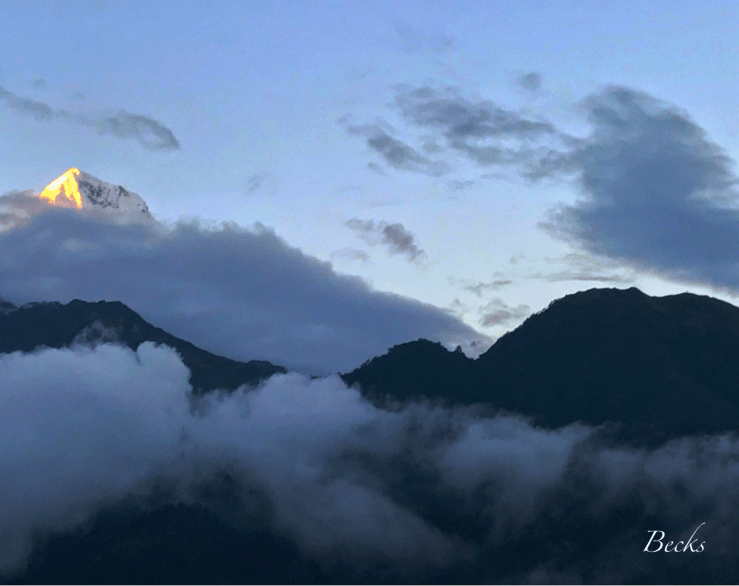
Day 3 – On Top of the World
Poon Hill
4:30 am. Time to rise and climb the last 40 mins to get to Poon Hill summit. Sunrise on top of Poon Hill was estimated to be around 5:30 am or so, and the trek is estimated to be just 40 mins, so there should be ample time. However, I have already warned the guide the night before that he needed to multiply the expected duration by 2 to better gauge how much time I would actually take. He wasn’t taking this heart, and still set the time at 4:30 am. Summit climbs to catch sunrise are not foreign to me. This would have been my 5th or 6th climb to a summit for sunrise, so I should be very comfortable trekking in the dark in wee hours of the morning. What I wasn’t prepared was how unexpectedly difficult this part of the climb was and how much I have underestimated it. I certainly felt my age this morning, conscious of the fact that I am the oldest in the group.
It was still dark when we started climbing. On the steps of the mountain, I couldn’t help but stopped and stared in awe at the sky lit by thousands of tiny stars. I have always wished that I could take a photo of the star-studded night sky one day. However, this wasn’t the time and place, and neither did I have the right equipment. I can only soak in the view as much as I could while trying to hurry up the steps. It wasn’t very long after that the first ray of orange was already visible from the corner of the sky, and I actually panicked! I was worried that I won’t be in time to catch the rising sun on the summit. How silly and utterly wasting the opportunity if I can only catch the sun after it rise? So I rushed myself even more, and with the uneven pace, the climb was extremely tiring for me. The night before our guide said that this part will be easy, and thus I was so unprepared, mentally. I remembered at one point I had to ask him to pull me up and practically drag me through those steps, less I decided to just give up entirely.


The summit is a flat platform with the watch tower in the middle, and a small store that sells hot beverage at the very hefty price, I was told. There were about 30-40 people parking themselves at the edge of the platform and below, waiting for the sunrise, and another 10 or so packed up the watch tower. The risk we took to do this trek during the monsoon season finally paid off. The spacious summit was all for our taking! With unobstructed view everywhere, we were free to take our photos at any angle we wanted. In the distance the jagged peaks of the Himalayan slowly began to grow lighter. As the last of the night sky disappeared with the rising sun, the eastern sides of the mountain gradually glowed with the orange rays of the sun. The cloud formation at the side was made even dramatic with the first light of the sun’s rays. As the sun rose over the horizon, the clear sky was a pure light blue as the world grew brighter; the magnificence of the Himalayan mountains was in full sight. I stood in awe at the immense beauty of nature, utterly humble and totally grateful for being given the chance to witness this glory in my lifetime.
We were the last of the few to leave the summit, after staying there for another hour or so. We took enough photos to capture everything possible, from group photos to individual shots; be it against the backdrop of the mountain peaks or over the signboard that says – Poon Hill 3210m, we have taken our hearts filled of photos, as though that would help us etch every single detail of this view in our memory.


By the time we reached back to our tea house, it was already 3 hours after. We believed we have fully earned the right to have a good breakfast, and opted for a traditional local breakfast of Gurung bread and eggs made to your own liking. Gurung bread is a sweetish bread that is typically served during breakfast. Made of flour it is puffed up, hollow in the middle. A big piece of this bread is equivalent to more than 2 slices of the usual loaf of bread, making it a much better option if you need the fuel to start the day. With a cup of black coffee, we are ready to be on our way to Tadapani.
“Deep” words of wisdom…
While getting ready to leave our tea house at Ghorepani, our guide gave us our entrance tickets to Poon Hill, bought at the checkpost at the bottom of the steps to the summit. The ticket read that the entrance fees of Rs 50 goes towards the conservation of Poon Hill Park and Poon Hill Primary School. Another evidence of the country’s reliance on tourism for social and infrastructure development. We were glad to be able to do our part for this country, one that just gave us one of our best experience in life. As we leave and turned our backs to the Poon Hill, our guide commented that we now had to leave the magnificent view behind us. I recall for that brief moment, I felt a pang of loss upon hearing these words. To this, our usually silent porter responded that we will still have these “great memories” with us. This coming from a man of few words was truly words of wisdom used at exactly the right moment.


Tadapani
We were in such high spirits going towards Tadapani. With a successful summit climb and having our hearts’ filled of wonders of the Himalayan, it was as though we had wings beneath our feet as we stepped back onto the path through the forest. Leaving behind the somewhat commercial Ghorepani, we were glad to be on our road. Not long after, we reached a plateau of sorts and immediately the space in front of us opened up to a 180 degrees view of the snow capped Himalayan again. Under the bright blue sky the whiteness of the clouds shone brightly, obscuring portions of the mountains, creating texture and depth to this majestic sight. The glorious view was so uplifting that we had to stop and take what would probably be the hundredth photo of the Himalayan mountains. It was as though we had a shot of euphoria; our guide even lifted up his voice and sang a song. Through his youthful tenor voice, the music flowed. Even though only a few lines of a local tune, we can already hear the potential. He used to sing at a pub before he became a guide, and I teased that if he so decide to give up trekking one day, he could always go back to be a singer.
 We passed by numerous waterfalls along our treks, some at least 3-4 storey high. This part of the trek followed close to the river and once again the sound of waters gushing downstream became louder as we trekked beside its bank for a better part of the trek. There was a particular series of stone steps that was wet with streams of water running down the path. It proved too slippery for my branded hiking shoes, and I slipped and fell. It is usually during such falls while mountain climbing that I was actually thankful for a very full butt that I spent my lifetime trying to slim down. Alternatively, I really could use a Kampung Adidas on my next trek. To this point, I humbly submit to my friend’s gloating as he promoted yet again, his faithful pair of Kampung Adidas upon hearing my plight.
At the bottom of the slippery steps, we came upon an impressive collection of stone stacks just on the river bank. Clusters of stones piled high and low of different heights made a photo-worthy sight. One particular stack stood taller than the rest and at its top were 2 smaller stack of stones. Whoever had the patience to create the stack and for whatever reason, it was certainly impressive. Having a collection of these meticulously assembled stone stacks by the river added a certain air of sacredness to the river and its surrounding.


We stopped by a tea house at the foot of a valley for lunch. It was situated along a river and the plan was to trek back up a little into the forest before we make our way down to our pit stop for the night. We had our usual Dal Bhat and this time, we actually have fresh greens, stir-fried not pickled. That was quite a refreshing change since this was probably the only meal in the mountains where we had fresh greens. I dug in heartily, although the taste was a little too exotic for my friend. As we were about to finish our meal, it poured! Rain was not unexpected, in fact every night the rain came. However, it usually rained only in the late afternoon. This day, the rain came a little too early just after noon. It wasn’t even a drizzle that we could still continue our trek, but heavy enough to trap us in the tea house for close to another hour. My friend took the opportunity to rest his throbbing head after taking medicine, while I engaged in casual conversation with another pair of trekkers. After 3 sentences into the conversation, I almost wished I hadn’t. It started with “so what do you do?” and upon hearing my profession, the trekker immediately jump into asking about career advice. There is a time and place for everything, but it was just not the right time and place to ask for career advice from another trekker whom you barely met, regardless of profession. Stick to the weather, it is a perfectly worthwhile topic for discussion in Nepal, especially when it was raining heavily at that moment.
Finally reaching Tadapani, we were quite exhausted with the long day, and welcomed the hot water from an electric heater. The hot shower gave us a boost in our spirit that lasted us through the evening while waiting for dinner. I decided I shall have chow mien, which I believe is invented purely for tourist. Besides getting a little tired of Dal Bhat, I felt obligated to respect the long standing practice of having a chow mien on a Nepal trek while my friend decided on a western fried chicken. My chow mien turned out to be a plate of noodles fried in chunky pieces of salt, but I ate it anyway since that’s the only dinner I’ve got. I bet the fried chicken, not exactly impressive by my friend’s standard, would still be better than my chow mien.
The Nepali Society…
As part of the essential briefing of the do’s and don’ts while on the trek, our guide covered things like don’t take photos of the locals without permission, don’t give money to children, save water and refrain from polluting the environment. The back of the menu of the restaurant at the tea house where we stayed in Ghorepani had a full page of such “gentle reminders”. It was very well-written and provided a glimpse of what the local think about us tourists. From environmental conservation to social etiquette, the long list is a reflection of the ideals of the natives.
Nepal’s close proximity to the stronger, larger nation of India, meant that the people have access to Indian channels on TV and Bollywood is immensely popular. However, in reality our guide explained the love hate relationship Nepal had with India. Rice from farms in Nepal were sold to India to be processed and re-sold back to Nepal. Nepal needs India to process the rice and then buy back these rice as the country’s rice is not meeting the local demands. The people recognize the problem, but lack the ability to change the situation.
India and Nepal are inseparable in its historical heritage. Both use the caste system as a mean of social separation, a system set up by a king in the 18th century. The rationale is heavily rooted into the concept of Hindu religion, aimed at directing people to specific roles that would fit the society as a whole. The rules of the caste system remained in the modern society of Nepal, an invisible lock over the younger generation as the older generation continue to perpetuate the caste ideals. The rule dictates that a higher caste is to be better treated and a lower caste needs to bow to the upper. Over dinner and long after during the many nights, our guide and porter set with us and tell us stories of the caste system and how the younger generation had to be bounded by these practices as part of the respect for their elders. Our guide is 2 castes below our porter but both of them continued to perform their respective jobs. Our porter always defer to our guide to make decisions and would follow the instructions to the letter. In return our guide treated him just like a buddy would. As equals, the strong friendship between them is an indication of a future with better social norms, one that the younger generation would work hard to build for themselves.


Day 4 – A Day in the Life of a Nepali
I would have thought that leaving Poon Hill behind the day before meant that there would not be any opportunity to get any more great mountain views. Imagine our very pleasant surprise when we woke up to the same snow capped mountains, layered over the village houses tops. As the sky gently woke up with the rest of the world, the view lit up slowly to reveal the now very familiar, yet always fascinating view of the white mountains. This morning the clouds were much thicker and after taking enough photos of the mysterious mountains much hidden behind the clouds, we sat down to our breakfast, while keeping a close watch over the clouds, just in case it cleared up for a clearer shot. When it finally did clear enough to reveal the complete tip of the summit, we quickly sped out to the front of the yard and to the second floor where our rooms were, in an attempt to compose the perfect shot of the view in every possible angle. To get the chance to see this view again was both a treat and a reminder of how blessed we had been on this trip. Counting our blessings, both my friend and I couldn’t help but agree on many occasions that our decision to travel during this period was right after all.


Leaving Tadapani heading towards Ghandruk, we spend a better part of the trek through the rhododendron forests. Rhododendron is the national flower of Nepal, which is a pity as this is not the season for the flower to bloom. If our trek occur between March to May, we would be able to see the sea of red flowers covering the higher mountains. However, even if this is not the blooming season, the woody trees of the forests together with the particularly thick mists this morning created an air of mystery and magic. Walking through the path sandwiched closely by tree trunks on left and right, it was as though the trees were silently extruding their presence. I cannot but stopped in the middle of the track and soaked in the enchanting atmosphere. A little down the path, we passed by a pair of handsome horses, standing tall in the middle of the path. We tread slowly beside them to get ahead. Turning back to steal another look, they starred back at me with steady gaze. Surreal yet hypnotic, time stopped for a very brief moment as our gaze locked.
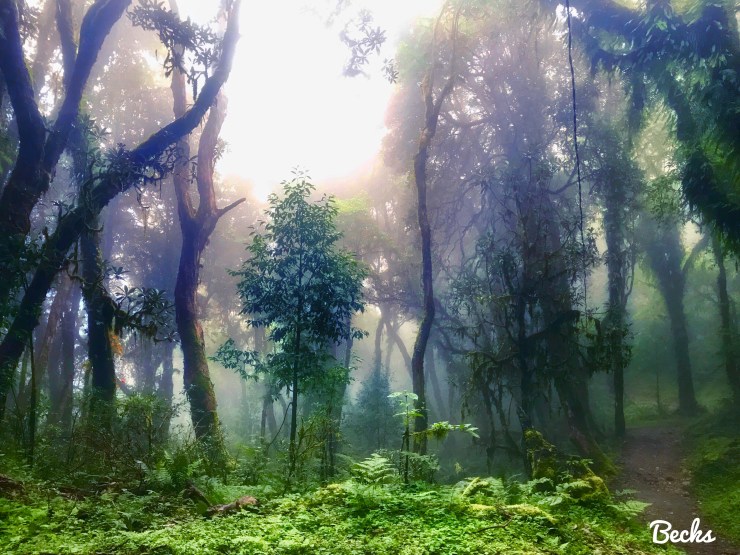
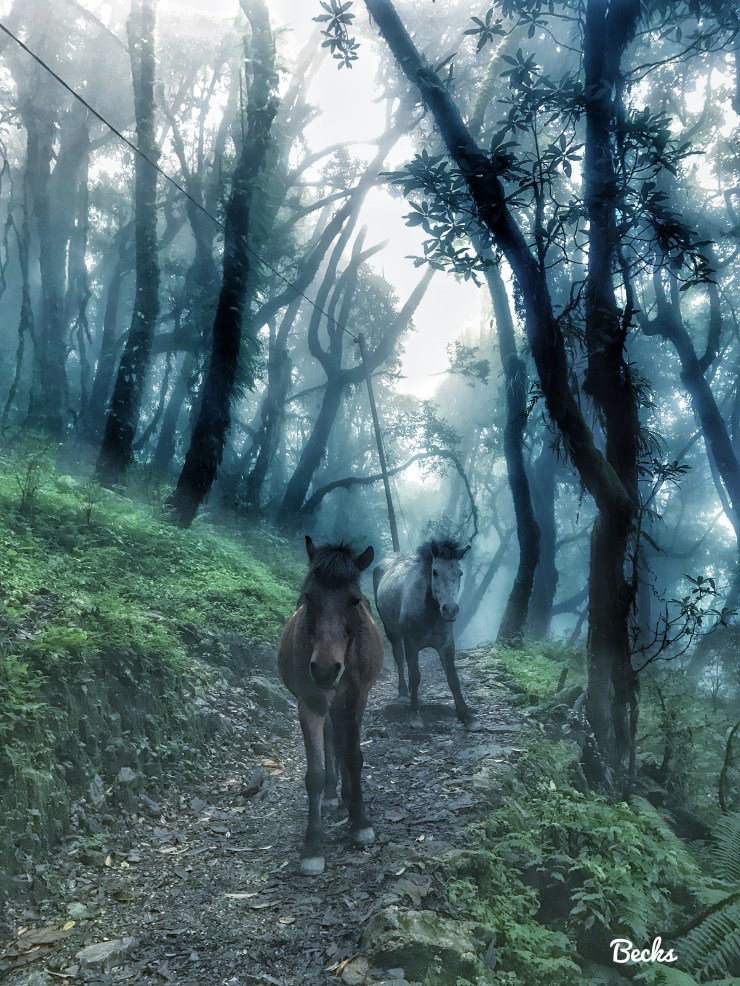
The path was damp with dew with puddles of water here and there. My guide reminded me again to watch out for leeches. I joked with him that we should take a bet on how many leeches we could get today. The conditions seemed right for a good catch of leeches. I said we can start at 5, since on Day 2 I’ve got 3 hanging by my pants. Before long I’ve caught 2, not on my pants this time, but dropped on my neck from the trees. I didn’t know why I would instinctively brush my hands over the back of my neck, but there it was, a wriggly thing on my fingers. I gave a shout and flung my hands hard to shake the leech off me. The second time one just felt unto my right hand holding on to my walking pole. Again, I flung it away out of reflex. It wasn’t painful, since they never got the chance to start sucking my blood, but it was slimy enough to make my hair stand. After a while, I casually told my guide to stop me from trying to get the leech of my hand the next time. I wanted to take a photo of it, just for remembrance. Quietly, my guide took the trouble to actually look for one, which incidentally wasn’t too hard to find, and placed it on his thumb. He raised it up so that I can take as many photos as I like on the little fellow. How sweet of him to sacrifice himself for the sake of fulfilling my wish.
We left the forests behind all too soon, and entered to the villages along the way to Ghandruk. Passing by one of them, a little girl in pretty red top and polka dot sleeves ran passed me with her mother following closely behind, calling out to her. The sight of a mother doting on the child tugged my heartstrings and I suddenly felt the urge to take a photo with the girl. I asked my guide to speak to the mother for permission, and in return, he asked that I give the little girl something. I dug up my crumbled nut bar and placed it on the girl’s chubby open hands. Sulking at her mother’s instructions, she stood beside me while we had our photos taken. When I got up to leave, I turned around to thank the mother and the child, the girl replied “welcome” in English and sped back to her mother with the nut bar in her hands.


Ghandruk
Our trek today was fairly short. By lunch time we reached the village of Ghandruk and checked into a very modern 4-storey guesthouse, quite like those hotels in Pokhara. I can’t say we were too impressed with the place, except for the attached washroom which made life a little bit more comfortable. Sadly, this also meant that our trek was fast coming to an end. With all the modern amenities, this place lacked any kind of character. Situated not very far from the entrance of the Ghandruk village, it reek of the smell of commerce. Disappointment cannot begin to describe it. I wondered if this was indeed the famous Ghandruk? Perplexed too, by the unusual short trek today, we wondered why we could not pressed on down and cover more distance? Over lunch, we found out we are going to take a walk through this village, the real one which was still a little distance down the hill.
Ghandruk is sizable village at 2010m, the home to the Gurung community. It is a well-established community and home to the famous British and Indian Gurkhas. The legendary fame of the Gurkhas is already well-known in Asia. Besides being valiant in the armies of the past, to this day the Gurkhas continue to be found in countries in Asia, holding positions such as security guards and policemen. The significant historical roles of the Gurkhas Contingent in the Singapore Police Force are the common stories of history textbooks in the school. In the early history following the separation of Singapore from Malaya, the Gurkhas were sent on a number of occasions to control racial riots. To this day, they continue to be recruited under stringent requirements and flown to Singapore for military training to strength our Police Force.

In recent years with the accessibility of roads further into the Annapurna Reserve, this famous village became more accessible and popular. We traveled light with only a jacket and walked down the path to reveal in “real” Ghandruk, a cluster of 20 or so greyish rows of houses. The distinct architecture of the houses in this village is the long row of windows over just one small door, the only entrance to the building, complete with tiled roof propped up by thick wooden sticks. The houses are connected by gentle steps and open up to a bigger compound shared by a few blocks. As we walked along the path, sometimes over the low walls, or even on the side of a roof, we saw the daily activities of the locals such as the women weaving cotton into cloth. The main religion of the village is Buddhism; we spotted rows of prayer wheels along the pathways and around the 4 outer walls of the temple on top of the a hill. Spinning the wheels in a clockwise direction is said to have mind stabilizing ability that will help to accumulate merit for the benefit of the future.


The main tourist attraction is Old Gurung Museum, a small place filled with the collection of antique items that depict the typical life of a Gurung in the Ghandruk village. A very impressive looking curved buffalo horns hanged over the entrance of the museum, flanked by the skeleton of a dog’s head on the left, and a monkey’s head on the right. Inside, the dimly lit room is a well-stock museum of everything related to the local culture, such as – kerosene lamps, containers weaved in bamboo, olden spinning and weaving wheel, Raksi pots, weapons, jewelry and musical instruments such as drums and violin look-alike. With our guide turned history teacher explaining most of the items, and even playing the instruments, this tour provided us with the most ancient and comprehensive education of Gurung living. Outside, there is a mail box but they ran out of postcards, else I would love to send a few to my friends back home.


A Taste of Nepali Culture…
No history lesson can be completed without a good understanding of local food. After some good nagging, my guide was happy to be able to find us a place in the village where we can get Chaang, a local alcoholic beverage, also made of millet like Raksi, with the difference of milk being added. It came in huge mugs, unlike Raksi that comes in shot glasses. It reminded me of baileys, and alcoholic tasted milk was never really my thing. I passed the rest out to the gang after taking in a few mouthful, and even my friend seemed to take that much better than me. I’ll pass and take Raksi anytime.
Next came the question of local snacks. Mindful that our trip was coming to an end very soon, we needed to bring back something to our office for our colleagues to try. It got to be something unique, something local. Our guide seemed quite stumped by this question. Besides being the loyal fan of Dal Bhat, there seemed to be no desire in him to try anything else in his diet, Raksi and Chaang aside. After much questioning in a couple of different ways to help him recall anything local, he mentioned that we can try to get Wai Wai, a deep fried packet of instant noodles that can be cooked or eaten as a snack. This is similar, if not the same, as Mamee, a local Malay snack that anyone in Singapore would have eaten when they were kids. This suited my friend very well as he believed that it would be very popular for his Nepali workers in his factory back in Malaysia. However, it probably cannot work for those highly critical colleagues of mine in my office.
I was almost prepared to go home empty-handed, when 2 days after we completed our trek, and over a home-made dinner hosted by the lady boss of the tour agency, this topic came up again. She suggested that I can buy a local sweet called Lapsy Candy. It is made of a local fruit commonly grown in trees around Nepal, preserved with sugar, salt, pepper and various spices. I was overjoyed to be able to find them at the airport store. Between my friend and I, we swept the shop clean of all Lapsy Candy.
Another local produce is honey. While we were hunting for Wai Wai at one of the bigger supermarkets along Pokhara Lakeside Road after our trek, we saw shelves of locally produced honey. The problem with local made goods in Nepal is that they lack any sort of packaging that would help to market the product. Shrink-wrapped simply in small plastic containers, the bottles of honey were barely noticeable, some even collecting dust on the shelves. If not for the the legendary wild jungle honey in this area, we would have walked away. Eventually both of us bought a couple of choice small bottles, and they did not disappoint us at all. Subsequently while talking to another friend of mine from India, I was told that the packaging were kept simple to keep the costs low so that even the locals can afford it. Makes sense, until the country realize they could have done better packaging for the lucrative tourist market, we shall look beyond the outer for the goodness within.
To complete our education on the Nepali Cuisine, we still need to find Sukuti. Sukuti is Nepal’s version of jerky, dried meat that can be made from buffalo, beef or mutton. It can be a dish or a snack. Our guide asked the kitchen of the fancy guesthouse that night, and unfortunately they don’t have any. It was only back in Kathmandu, the day before our departure, at a roof-top cafe, where we finally found Sukuti on a menu. What came out was a sourish spicy starter of sliced dried meat and onions. It was fine as a dish, but I was sure this was already westernized for the foreign taste buds.


Dinner that night was a great feast of every thing that seemed nice on the menu. Partly because it was indeed our last night together with our guide and porter, and partly also to thank them for being such great companions, we were happy to order anything they would have liked, especially fried chicken. Fried chicken is done western style, and to me it is no different from any fried chicken. My friend, a connoisseur for fried chicken, seemed pleased with it. If anyone is bothered enough to make fried chicken from scratch at home, it would be him. I’ll take his standard for this dish anytime. I took the opportunity to complete my last yet-to-order item from the menus of most mountain tea houses, the Mo Mo. This is essentially the Chinese dumpling. In Nepal, this dish is of Tibetan origin, brought to the country by the Tibetan diaspora in the 1950s. Since then it became the traditional dish of the Newar community in Kathmandu Valley. I’ve put off this dish to the last since I wasn’t to keen to try food too close to home. However, I wasn’t disappointed at all. It came well-wrapped and the filling was tastefully done. Dipping into the chilli sauce, the four of us finished it in no time, and I barely stopped myself at the last 2 pieces and took a photo of it before it was totally gone.
Our guide and porter naturally suspected something fishy when we started to order so many food, since on the most tiring days, we would refuse second helpings. They were a little overwhelmed by us and the food, and felt obliged to be prim and proper. Half way through, we were just a little amused and more saddened by them discarding their usual hearty eating practice of using hands but were using forks and spoons instead. I could almost feel their discomfort since I would be most awkward using my hands as they would be using forks and spoons. In an attempt to emulate us they lost the joy of being themselves. With the rapid westernization of the younger generation in Nepal, I am sure the cultural roots and their simple way of living would inevitably be lost along the way.


Day 5 – Coming full circle
I was awaken by loud knocks on my door. Awoken with a start, I made myself proper before I opened the door to find out what happened. Our porter was pointing out to the sky and there it was, the good weather and the most gorgeous view of the mountains, this morning with a different angle. The weather was indeed turning as the clouds were a beautiful alto-cumulus right across the sky. The orange ray of the rising sun shone from the left, peeping just a little above the mountain tip, creating a series of long-tailed starbursts. Since it was our final day in the mountains, we soaked in the snowy mountain view as much as we could. Even after breakfast when the sky was already bright and blue over the formidable mountains, we were still there on the balcony for one last time, watching; wondering; lost in thoughts. I am thankful for countless occasions where the good weather brought us great views of the mountains. Humbled, I felt unworthy of the goodness that this trip had given me. It was almost too good to be mine. My heart was filled with blessed happiness and I would always remember this blessing upon me. Subsequently, when life gets tough going, I would recall this blessing and tell myself that there are still much goodness waiting for me out there, all I need to do is to hold on tight, and all will be fine.


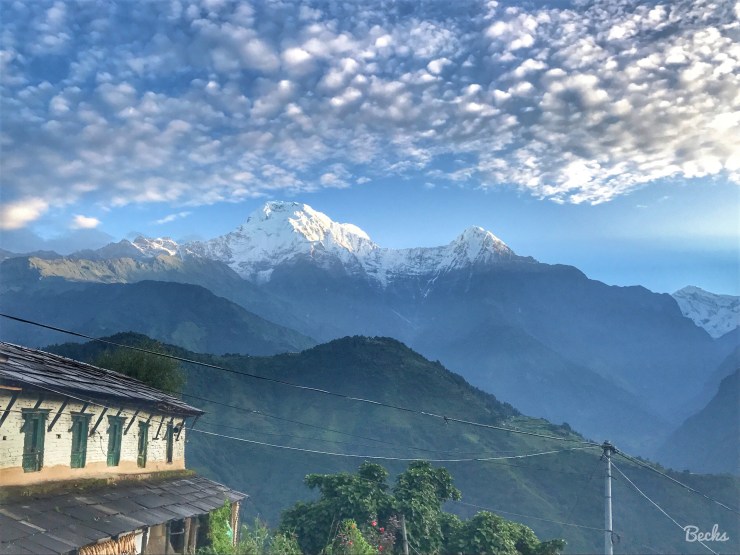
Leaving Ghandruk, we trekked back to the cheerful countryside. This day, everything around us were basking under the sunny bright sky, and everywhere there seemed to be heighten activities. As the tourists season picked up, there were significantly more traffic of mules carrying supplies up the hills, cows trotting along the path where the farms were situated over the vividly green terraced slopes. Even the number of tourists we met along the road also increased. Annapurna is rapidly gearing up for another busy tourist season.


Trekking through the last bit of countryside, we tried our very best to hold on to every single detail of the surroundings we had now grow to love so much. With 180 degrees view of the undulating hills carrying their waterfalls within the dense forests, we followed the Modi river downstream where huge rock formations loomed high over us, signalling the end that was just round the corner. In a very short period of time this morning, we experienced the gayest variety of sights, sounds, locals, animals; all familiar, some new. They were all jumbled up to give us a blast of the grand finale to a most wonderful experience of the Nepal Poon Hill Trek.


Epilogue
We reached the checkpost of Nayapul, the starting point of our trek 5 days ago. We were now checking out. The feeling of checking in vs checking out was so different. Checking in – the anticipation of a long and tiring trek outweighed everything. Checking out – the feeling of accomplishment mixed with the deep desire to stay in the mountains for just another moment was so strong that it almost ached. The trek changed something in me, and this checkpost is the witness of the before and after. Turning back to glance at what I would be leaving behind, I bowed in a silent prayer of thanksgiving for all that I was bestowed during this trek.
At Pokhara hotel, we parted our ways with our guide and porter, now our friends in this foreign land. Five days spent with them, almost every waking moments. Crossing hills and mountains, braving leeches and rain, we laughed at one another’s jokes and matched the pace of our companions along the road. Our experience had already made us fast friends. We will continue to connect on-line, until the next time we meet again in Nepal, on one of the treks, where we resume our friendship under the formidable Himalayan mountains.
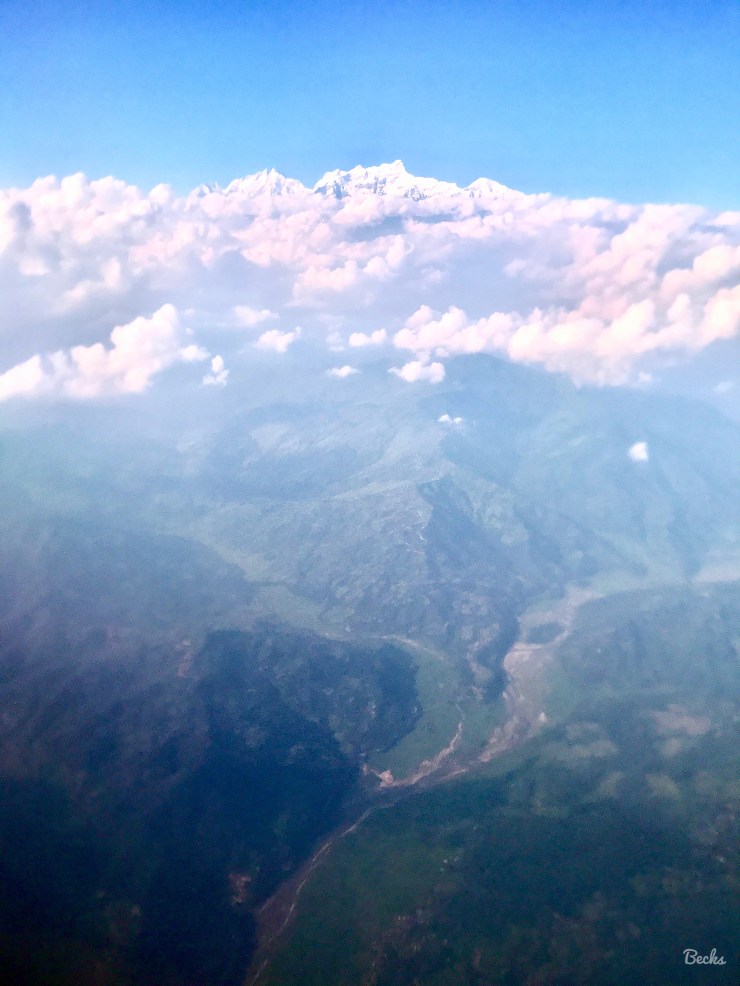
A day later we took the jet plane from Pokhara to Kathmandu to avoid the long bus ride. High above the clouds jut out the highest peaks of the Himalayan mountains. Is that Everest? Surely it got to be? With the green plains way below the clouds, yet visible, we promised ourselves that this would not be the last trip to Nepal at all. There are much more to see and experience in this country. I sincerely believe that this shall be the start of many more wonderful trips to come.


a trip of a lifetime for sure. Well done
LikeLike
Most certainly!
LikeLike